What types of diagram are used in IELTS Academic Writing Test Task 1?
It’s very important that you know what to expect in your Academic Writing Test Task 1 before you take your test. Knowing what you could face will boost your confidence, and will make sure you’re thoroughly prepared.
So, what types of diagram are there? There are 6 different ways of presenting data. Let’s go through them one by one.
Line graphs

These show changes over time and are therefore called ‘dynamic’ diagrams. Unfortunately, it’s highly unlikely that you will be presented with a simple graph with just one line of data. You will almost certainly have a graph with multiple lines of data, or a graph where the data is presented on top of other data. Make sure you practise describing both of these line graphs.
What language do I need to describe line graphs?
You will need:
Verbs + adverbs, and adjectives + nouns that show change e.g. rose dramatically / a dramatic rise
Approximations e.g. nearly, around, a little over etc.
Prepositions to indicate change e.g. rose from 20% to 30% etc.
Prepositions to indicate time e.g. between 2023 and 2024 etc.
Pie charts
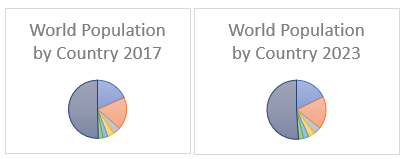
These show proportions, or parts of a whole. A single pie chart is static – it does not show change over time. But if there are two or more pie charts about the same topic but with different dates (as above), then they do show change over time. So, again, make sure you practise describing single and multiple pie charts.
What language do I need to describe pie charts?
You will need:
Nouns to describe proportions e.g. fractions (a quarter), percentages (25%), ratios (one in 4)
Approximations e.g. nearly, around, a little over etc.
Bar charts
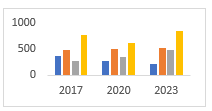
In some ways, bar charts combine the functions of both line graphs and pie charts. So, they show proportions and change over time. The good thing is that you can use the same language to describe bar charts as you have already practised for line graphs and pie charts.
Tables
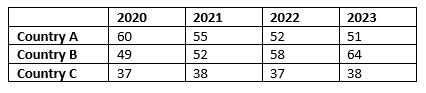
My students find tables quite scary, but remember that tables are just showing the same data as line graphs, pie charts and bar chart. The trick is to see the changes in the numbers in the same way as you do for lines, pie slices and bars!
The good news: you should use the same language as you’ve practised with the other data types!
Process diagrams
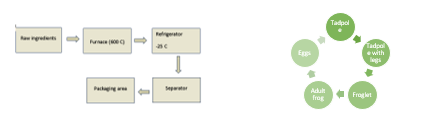
There are two types of process diagrams. The first, and I think the most common, is a diagram showing how something is made or produced e.g. how glass is made. Manufacturing processes tend to be linear from the beginning to the end. The second type is a natural process e.g. the life cycle of a frog. Natural processes are frequently circular, so no real beginning or end. You have to decide where to start your report!
What language do I need to describe process diagrams?
Appropriate verbs that are often used in the present passive voice e.g. The ingredients are added to the furnace.
Sequential linkers e.g. Firstly, next etc.
Relative clauses e.g. The water, which has been heated, is added to the mix.
Maps or plans
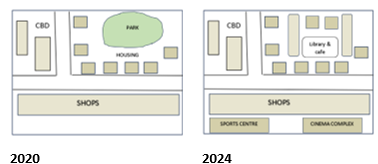
Maps show areas of a country or city or, perhaps, an island, whereas plans usually show the layout of a building. There are normally two maps or plans to describe. One map/plan has one date, the second another date. Your job is to describe what changes have taken place, or will take place.
What language do I need to describe maps or plans?
Nouns to describe geographical features (forest, coast, hills etc.), parts of a town or city (museum, shopping mall etc.), or parts of a building (lobby, meeting room etc.)
Nouns/verbs to describe changes to towns or buildings (urbanise, expand, demolish, renovate etc.)
Prepositions of position (in the north, on the coast, opposite the entrance etc.)
Make sure you practise all 6 types of diagrams before you take your IELTS test. And remember, you could have a question with 2 or more different diagrams, so that makes it all the more important that you practise and feel confident with all 6 types!
To learn more about IELTS Academic Writing Task 1:
Read our other blogs
Come to our free monthly lessons
Get our on-demand Academic Writing Task 1 lesson packs.
Team IELTS is here to help you prepare for your test.
Good luck!