How to improve your spelling for IELTS
Across the IELTS Test, your spelling is tested in a variety of ways. In the Listening Test, even if you have the correct answer, you will not receive the mark if it is spelled incorrectly. The same is true of the Reading Test, you need to ensure that any words you use from the text to answer questions are copied correctly in order to gain the mark. Writing is probably the most obvious section of IELTS where you need to make sure that you make as few spelling mistakes as possible.
To improve your spelling, it’s important that you start NOW! Use this time before your test to get to grips with learning vocabulary and improving your spelling in English.
1. Read, Read, Read!
One of the best ways to improve your spelling is by reading as much as possible. Books, articles, newspapers, blogs like this one, and even social media can expose you to how words are spelled in context. The more you see a word, the more familiar it will become. Try to choose texts that cover the range of topics that are typical in IELTS e.g. environment, education, travel etc. This means that you’ll come across vocabulary that might come up in the test. It also has the added bonus of helping you expand your world knowledge on topics that could be covered in the test. You could use English language news sites such as BBC news to help you find articles to read.
2. Keep a vocabulary notebook
While you are reading, it’s important that you record your vocabulary in something like a personal notebook, journal or a notes file on your mobile phone.
How to record vocabulary:
Write the word: Note down the word you would like to learn.
Write its part of speech: Identify if it’s a verb, noun, adjective, adverb etc. This tells you how to use it in a sentence.
Break it down: Divide the word into syllables or parts to make it easier to remember.
Use it in a sentence: Create a sentence using the word to understand its context.
Review regularly: Go back to vocabulary regularly, add another sentence every time or try to test your own memory of the spelling.
3. Practise with flashcards
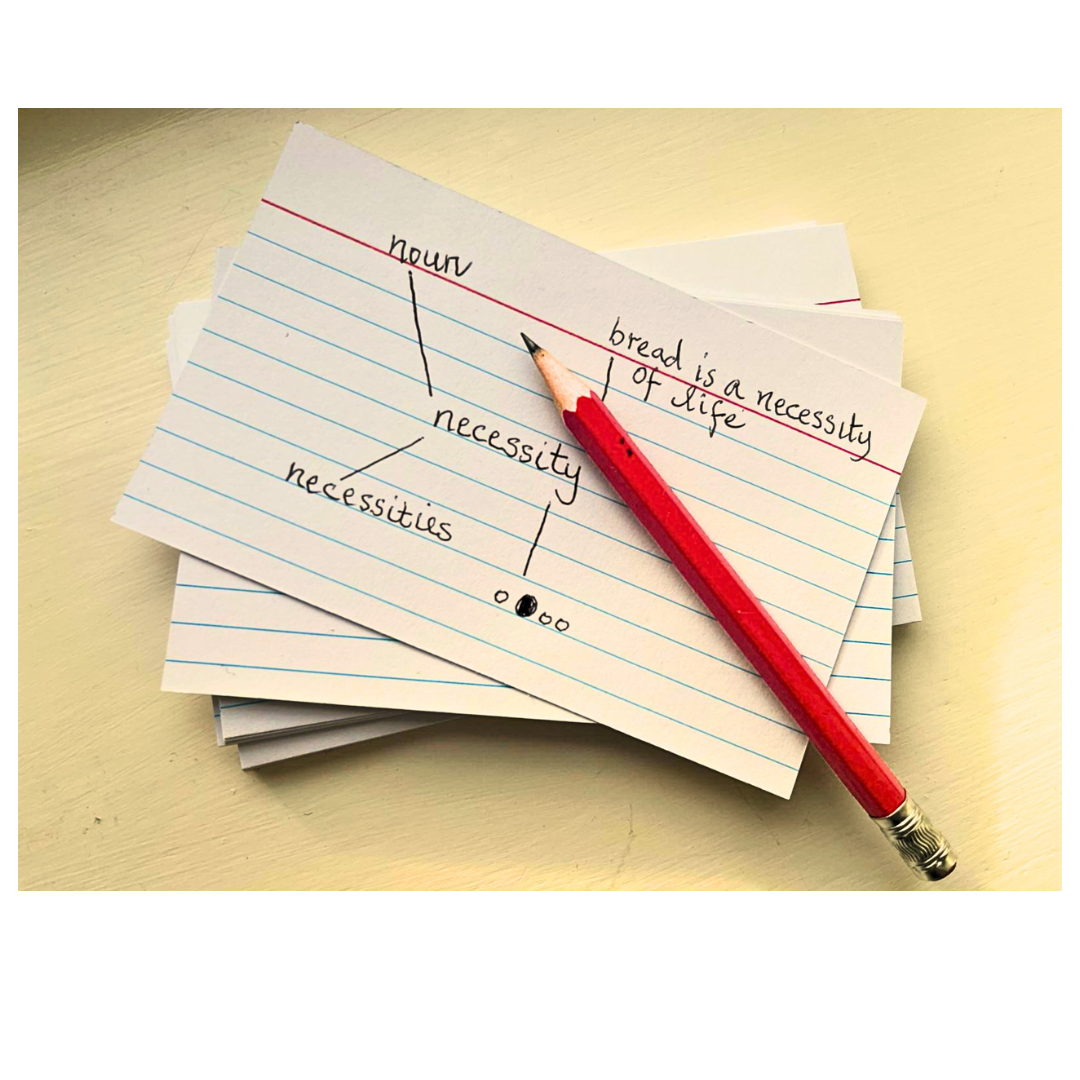
Flashcards are a simple yet effective tool for memorising spelling. You can create physical flashcards or use apps if you are more comfortable with technology.
Steps to create flashcards:
Front: Write the word you want to learn.
Back: Write the definition and a sentence using the word.
Review sessions: Test yourself regularly or ask a friend to test you.
4. Learn common patterns and rules
While there are many exceptions, English does have spelling rules and learning the most common ones can help you out when you are struggling to identify if your spelling is correct. For example:
“I before E except after C” (believe vs. receive).
Words ending in “-y” often change to “-ies” in the plural (library → libraries).
Focus on rules that are relevant to the words you’re struggling with the most.
5. Use spelling games
Games like Scrabble, Boggle, or online quizzes challenge you to think about word structures and improve your spelling while hopefully actually having a bit of fun!
Online Resources:
-
Wordle: I love this game! I play it every day and get my students to do the same.
6. Find your common spelling mistakes
Every time you write something, take a moment to go back and check your spelling. The more often you do this, the more you’ll be able to identify the mistakes that you tend to make. If you prefer to practise your writing on a computer, you can even use the spellcheck function to do identify your mistakes for you and take a note of everything that has been marked as incorrect, keeping this in mind the next time you write. You can also get others to help you. Ask a friend, family member or teacher to read your writing and identify any of the spelling mistakes. It’s important that you develop this routine of checking your work so that on the test day, you’ll be much more able to spot and correct your mistakes on your own..
Final Thoughts
Keep practising, stay curious, and enjoy the process of learning. After all, every mistake is just another opportunity to learn. You’ve got this!
What are your favourite ways to improve your spelling? Share them in the comments below—we’d love to hear from you! 😊
For further help with your vocabulary, check out our vocabulary packs.
And don't forget to check out our FREE MONTHLY LESSONS and our LESSONS ON DEMAND
2 comments

Team IELTS, thanks for the article on spelling. I love the idea of reading more helping with spelling by seeing the English words more. Also, love the game wordle as I use it with my class.
With lower level students, I use word search and wordshake as well.
Keep up the great work,
Mary

Hi Mary
Thanks for the feedback!