Numbers and symbols in IELTS Academic Writing Task 1
Writing numbers and symbols
As I’m sure you already know, IELTS Academic Writing Task 1 usually requires you to describe data – numbers, percentages, fractions etc.. The data is often presented in the form of a table, a pie chart, a line graph or a bar chart. Difficulties can arise, though, in how to write that data in your report. So, in this blog, I want to go through some of the advice I have given my students in my IELTS preparation classes about writing numbers and symbols in their descriptions of diagrams and figures.
First piece of advice: for numbers, write the digits not words.
So, write:
24 not twenty four
118 not one hundred and eighteen
28th not twenty eighth
The reason? The main reason for doing this is to avoid spelling mistakes. It is so easy when you are taking the test and feeling pressurised to make simple spelling mistakes. And it doesn’t help that the spelling of numbers in English can seem a bit illogical. For example, four, fourteen but forty, five, fifteen and fifty. Another reason is that it is so much quicker to write the digits rather than the words. Look at this example: 1 648 272. Would you rather write that or would you prefer to write: one million, six hundred and forty eight thousand, two hundred and seventy two?
There is one exception though. In good academic writing, if the sentence begins with a number, that number should be written in words.
Seventy percent of all students said they preferred afternoon lectures to evening lectures.✔
70% of all students said they preferred afternoon lectures to evening lectures. X
When asked, 70% of all students said they preferred afternoon lectures to evening lectures. ✔
Second piece of advice: for larger numbers do not use commas (or full stops).
So write:
1 648 272 or 1648272
350 118 or 350118
42 570 or 42570
2672
The reason? In British and American English, we use commas to separate millions and hundreds or tens of thousands whereas in other countries, perhaps yours, large numbers are separated by full stops. For example, if the number you need to write is two hundred thousand, write 200 000 because, if you write 200.000 that number is two hundred point zero zero zero, that is, it is the wrong amount!
So, to avoid making this sort of mistake don’t use either commas or full stops. Just write the number as it is. If you want to, you can leave a space between the million, hundreds or tens of thousands.
Again, there is an exception and that is for decimals. For decimals you must use a full stop (point) and must not use a comma or leave a gap. So, we would write three point five as

not as

Third piece of advice: if you know what the symbol or abbreviation is, then use it.
So, write:
81% not 81 percent or 81 per cent
30 km or 30 kms not 30 kilometres
17g or 17gm or 17gms not 17 grams
$25 not 25 dollars
£30 not 30 pounds
The reason? The reasons for this are the same as for writing numbers as digits rather than words – to avoid spelling mistakes, and for speed. But, if you don’t know the correct symbol or abbreviation, then write the actual word. Better safe than sorry!
Why don’t you watch our webinar lessons on Line Graphs and Pie Charts to find more examples of how data is written?
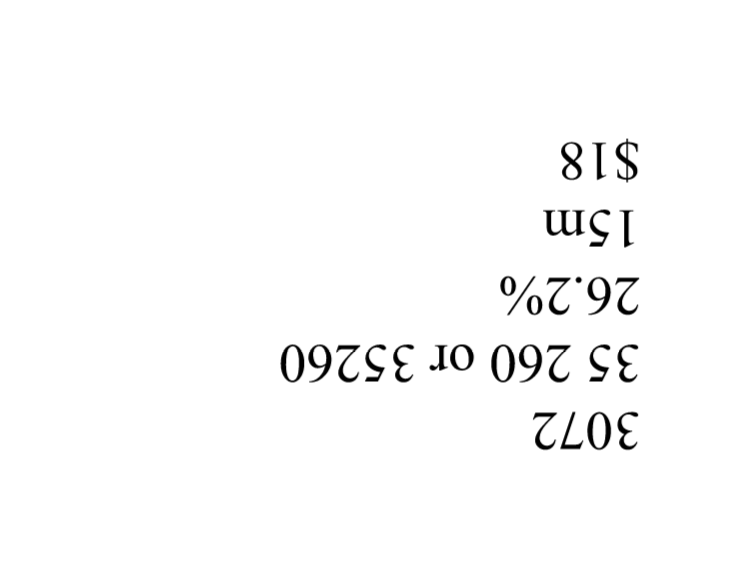
Let’s finish this blog with a quick quiz! Write the following in numbers with the correct symbols and/or abbreviations. The answers are on the right.
Three thousand and seventy-two
Thirty-five thousand, two hundred and sixty
Twenty-six-point two percent
Fifteen metres
Eighteen dollars